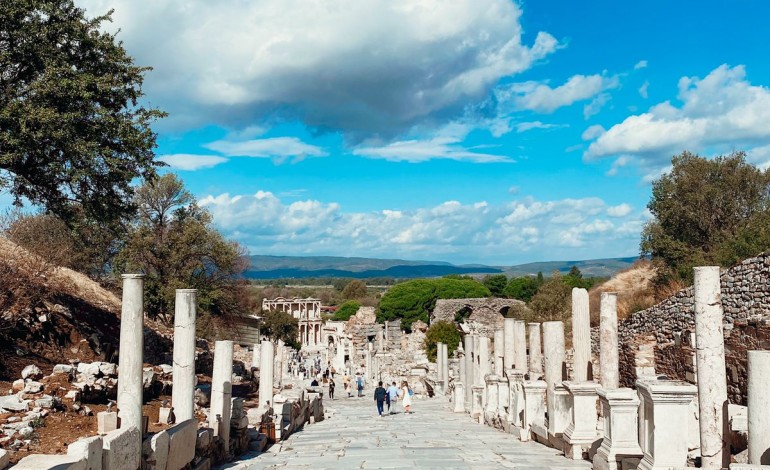
According to ancient
historians the myth of the foundation of Ephesus goes back to the period before
the Ionian colonization. As it was customary in ancient times to consult the
oracle before any important event, Androclus, the son of Codrus, the legendary
King of Athens did this about where to settle or found a settlement. The answer
was simple: ‘’at the place which will be indicated by a fish and a wild boar’’.
After colonists landed in Anatolia, they were camping samewhere near Ephesus
and were grilling fish. A burning fish set a bush on fire causing a boar to
leap out of the bush and run away. Remembering the words of the oracle the
colonists decided to found their settlement there.
Some sources say
that the city was founded by the Amazons. The city was an Ionian colony formed
sometime after 1000 BC. Some authorities have suggested that the history of the
city which the hittite called Apasas. The earliest archeological evidence is
the Mycenaen ceramics found on the Ayasoluk Tepesi (Hill). This does not imply
that there had been a Mycenaean settlement in the region of Ephesus. Mycenaean
ceramics were popular and found in many other places.
Ephesus has been
located at diffrent places in diffrent times. Ephesus I was located on Ayasuluk Hill and inhabited by ancient
Anatolians, Carians and Lelegians. At that time there was a cult of the Great
Earth Mother which acted lika a magnet attracting pilgrims and settlers even
before the Ionian migration. Ephesus II was on the North slope of Panayır Dağı
(Mount Pion). As with other cities of the Aegean coast of Anatolia, Ephesus
came to be ruled by Croesus of Lydia in the mid-6C BC, before passing to the
Persians in 546 in BC. It joined the Delian League after the Persian Wars. In
334 BC it fell to Alexander the Great and subsequently to his successors:
Lysimachus and Seleucrid rulers. In the 4C BC the harbor threatened to silt up
the settlement and it was moved to a new location between Panayır and Bülbül
Dağ (Mount Coressus) by Lysimachus to form Ephesus III. The remains of city
walls from this period can still be seen on the slope of Bülbül Dağ (The
Nightingale Mountain). Later it was controlled by PErgamum, eventually passing
into Roman hands in 133 BC. During this period, Ephesus became the capital of a
province of Asia Minor and the population reached a quarter of a million. After
the 6C AD, due to the persistent silting up of the harbor and repeated raids by
Arabs, the city changed its location back to Ayasuluk Hill forming Ephesus IV.